
Why do we use work-based learning at Grow?
When Grow launched in 2018, we wanted to create an approach that prioritised learning in a practical way but… it’s often all too easy to slip back into a traditional theoretical approach to learning that most of us are accustomed to.
In our first year of running programmes, I was midway through a coaching session when I had a very clear but simple revelation. It was one of those lightbulb moments that makes you question why you hadn’t worked it out before…
The situation
I was coaching a group of young people on problem solving skills. The group was entirely made up of young people who hadn’t enjoyed education and had struggled in a ‘classroom’ environment. During the session I was giving examples, introducing role plays and suggesting theoretical scenarios… They sort of understood what I was talking about and we created some ‘potential’ solutions to our ‘potential’ issues.
The revelation
And then I had my light bulb moment. If you want people to learn problem solving skills, you need to give them an actual problem to solve and support them through the process of solving it.
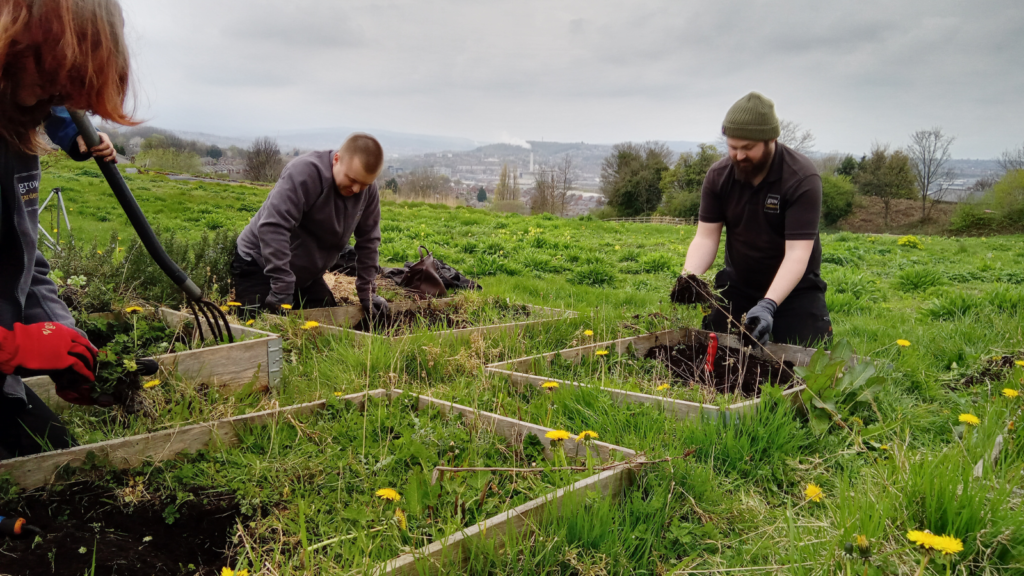
At its very core, this is the basic principle of work based learning. Rather than flooding someone with theory, expose them to a ‘real’ situation and coach them through developing the skills on the job. By working alongside young people, demonstrating skills, sharing feedback, we can encourage and support this ‘real’ experience.
It’s funny how uncommon this approach can seem but when you look at most of our experience of the education system, it’s not surprising that we’ve needed to rediscover more of a work based approach to learning. You don’t have to delve too far back into history to see that this ‘apprenticing’ and learning on the job model was, for generations, how people developed new skills.
So, if you ever hear the Grow team talking about our ‘work based learning’ approach, this is exactly what we mean. We’re not trying to develop employability skills from a textbook or solely on a white board (though we do love a whiteboard). We spend time outdoors, in active and real situations in order to really embed new horticultural and essential soft skills. In doing this, the skills are not simply a cerebral thing but they are embodied and practised, forming part of a young person’s muscle memory and with practice can become intuitive!!
Steven Cotton
Managing Director